
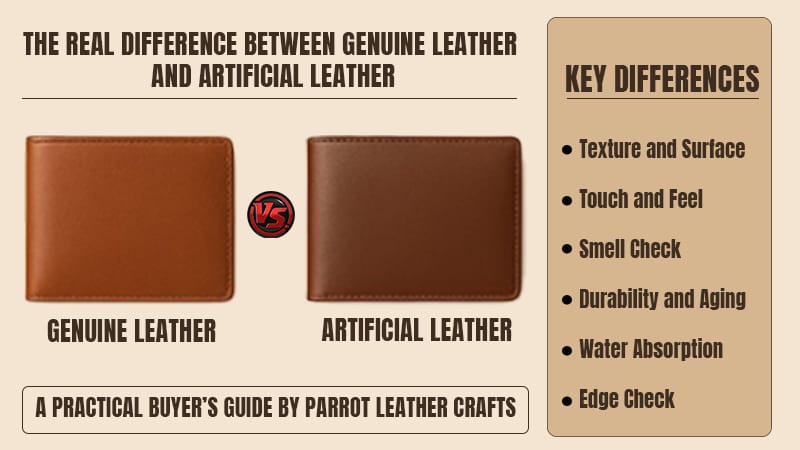
A Practical Buyer’s Guide by Parrot Leather Crafts
Have you ever picked up two leather wallets that looked almost the same, but one cost three or four times more than the other?
Many of our customers at Parrot Leather Crafts ask us this question every day:
“Why is Genuine Leather so much expensive than artificial leather when they pretty much look alike?”
Honestly, it’s a fair question. Modern technology has made fake leather look really good. But when you go deeper — the touch, smell, usage, experience and durability of both — the difference becomes crystal clear.
Therefore, in this article, I am going to explain the difference between Genuine Leather and Artificial Leather using simple and pragmatic terms based on real knowledge and hands-on experience.
What is Genuine Leather?
Genuine Leather comes from real animal hide. Usually, it is from cowhide, but it may also be from goat, sheep, buffalo, or some other animals.
At Parrot Leather Crafts, we use higher grades of cow leather for making the leather goods. Being the products of genuine leather it offers:
- Maximum durability
- Natural texture
- Excellent aging quality
Unlike artificial materials, genuine leather comes from a living source. This means it changes, breathes, and ages naturally, becoming more beautiful over time.
Types of real leather
You might notice several leather types when looking around:
1. Full-Grain Leather
The best quality, made from the top layer of the hide, that retains all of the hide’s natural markings and will develop a beautiful patina over time.
2. Top-Grain Leather
Slightly polished for a smoother surface, good balance between durability and beauty.
3. Genuine Leather (Grade)
Real leather; however, made from lower layers of the hide. Still natural but not as strong as full or top grain.
In this post, by Genuine Leather, I mean real leather made from animals in general.
What is artificial leather?
Artificial Leather is a manufactured material.
It is also known as:
- Faux Leather
- PU Leather
- Synthetic Leather
- Vegan Leather
This material is made by applying a coating to a fabric base, often of polyester or cotton, with plastic-like PVC or PU to provide the leather appearance.
Artificial leather has improved a lot in appearance, but it is still plastic, not natural hide.
Key Differences Between Genuine Leather and Artificial Leather
Now let’s break this down into real-world differences you can feel and test.
1. Texture and Surface
Genuine Leather:
- Surface is natural and uneven
- Visible pores and unique patterns
- No two pieces look alike
Artificial Leather:
- Pattern is repetitive
- Very smooth and uniform
- Often looks too “perfect”
Real leather is from nature, and nature never makes copies.
2. Touch and Feel
From my experience working directly with leather for years, this is one of the easiest tests.
Genuine Leather feels:
- Warm
- Soft yet strong
- Slightly stretchy when pressed
Artificial leather feels:
- Cold
- Plastic-like
- Rigid, with no natural stretch
3. Smell Check
This never lies.
Genuine Leather smell:
Rich, earthy, natural. Once you smell it properly, you’ll never forget.
Artificial Leather smell:
Chemical, plastic, or vinyl-like. Like those cheap car seat covers or raincoats.
4. Durability and Aging
This is where Genuine Leather really pulls ahead.
Real leather develops a beautiful patina over time — a natural shine and character from use.
Artificial leather, on the other hand:
- Begins cracking
- Peels after some years
- Gets ugly instead of better
Customers are still using our leather bags after 8–10+ years at Parrot Leather Crafts.
5. Water Absorption
Put a drop of water:
✅ Genuine Leather:
Because it has pores, it absorbs slowly.
❌ Artificial Leather:
Water stays on the surface like on plastic.
6. Edge Check
Check the cut edge:
- Genuine Leather → Fibrous, rough edges
- Artificial Leather → Smooth, layered, plastic-looking
Genuine Leather vs Artificial Leather: Comparison Table
| Feature | Genuine Leather | Artificial Leather |
| Source | Animal hide | Plastic on fabric |
| Breathability | High | Low |
| Durability | 10–20+ years | 2–5 years |
| Odor | Earthy, organic | Chemical-like odor |
| Aging | Develops patina | Cracks & peels |
| Maintenance | Needs conditioning | Very low |
| Price | Higher | Cheaper |
Why Choose Genuine Leather?
Here’s why we always recommend Genuine Leather for customers looking for long-term value:
- It lasts for years.
- It is comfortable and airy.
- It looks better as it ages.
- It holds resale value.
- It gives a premium appearance.
A real leather bag or wallet is not an expense; it is an investment.
Why do some people choose artificial leather?
We also respect certain reasons people choose alternatives:
- Budget limitations
- Vegan lifestyle
- Fast fashion or trend-based fashion items
- Short-term use
Artificial leather has its place, but it can’t replace real leather in quality and service life.
How to Maintain Real Leather
At Parrot Leather Crafts, we always educate customers about leather care.
For Genuine Leather:
- Gently wipe with a soft cloth
- Use leather conditioner every 2–3 months
- Avoid exposure to extreme heat and water
- Do not use hair dryers to dry it
For Artificial Leather:
- Clean using mild soap and a damp cloth
- Avoid long sun exposure
- No oil or conditioner needed
Final Thoughts: Which One Should You Buy?
Here’s the honest answer:
If you want something that will last for years, age beautifully, and represent true quality —
👉 Choose Genuine Leather.
If you just want a temporary fashion product or budget option,
👉 Artificial leather is acceptable.
At Parrot Leather Crafts, we believe that real leather is more than just a material; it’s a lifelong companion.
Next time you go shopping for a bag, wallet, belt, or shoes, don’t just look at the shine; check the texture, smell, edges, and feel.
Because now you know the real difference.