Walk through New Market, Elephant Road, or any Facebook shop feed in Bangladesh, and you’ll see the same word everywhere: “genuine leather.” The problem? Many of those products are PU, rexine, or bonded scraps dressed up to look like the real thing — often sold at real-leather prices.
If you’ve ever paid 2,500 taka for a “leather” wallet that peeled within six months, you know the frustration. The good news: once you know what to look for, spotting fake leather takes under two minutes at the shop counter.
This guide explains exactly how to identify genuine leather products in Bangladesh, the tricks used in our local market, and how to make sure your next wallet, belt, bag, or pair of shoes is worth every taka.
Why Genuine Leather Matters
The difference between real and fake leather shows up in durability, comfort, and long-term cost.
A well-made genuine leather wallet from a reputable Bangladeshi maker can last 5–10 years, softening with use and developing a rich patina. A PU wallet typically starts cracking or peeling within 1–2 years — sometimes sooner in Dhaka’s humidity.
There’s a money angle too. A fake leather bag at Tk 1,800 that dies in a year costs more over time than a genuine one at Tk 4,500 that lasts a decade. Smart buyers focus on cost per year of use, not the price tag.
And remember: Bangladesh has one of the largest leather industries in South Asia, with Savar serving as the country’s main leather processing hub. There’s no reason to settle for plastic imitations when quality leather is made right here.
Different Types of Leather (Know the Grades Before You Buy)
Not all “real leather” is equal. Sellers often use grading terms loosely, so understanding these four categories protects you immediately.
Full-Grain Leather
The highest quality. Full-grain uses the entire top layer of the hide with the natural grain intact — including small scars, pores, and texture variations. Those “imperfections” are proof of authenticity. It’s the strongest grade and develops the best patina. Many craft-focused brands in Bangladesh, including Parrot Leather Crafts, often use full-grain or top-grain leather for premium wallets and belts because of their durability and finish.
Top-Grain Leather
The second-best grade. The top surface is lightly sanded to remove blemishes, then finished. Slightly thinner and more uniform than full-grain, still very durable, and common in quality bags and shoes. For most buyers, top-grain offers an excellent balance of price and longevity.
“Genuine Leather” (the Grade)
Here’s where confusion begins. Ironically, “genuine leather” as a grade refers to the weaker lower layers left after the top layers are split off. It’s technically real leather, but less durable and often heavily coated to look better than it is. When a Tk 800 belt says “genuine leather,” this is usually what you’re getting — if you’re getting leather at all.
Bonded Leather
The lowest tier. Bonded leather is scraps and leather dust glued together with polyurethane, then embossed with a fake grain. It peels, flakes, and fails quickly. Avoid it for anything you use daily.
Quick rule of thumb: Full-grain > Top-grain > Genuine (grade) > Bonded. If a seller can’t tell you which grade they’re selling, that’s a warning sign.
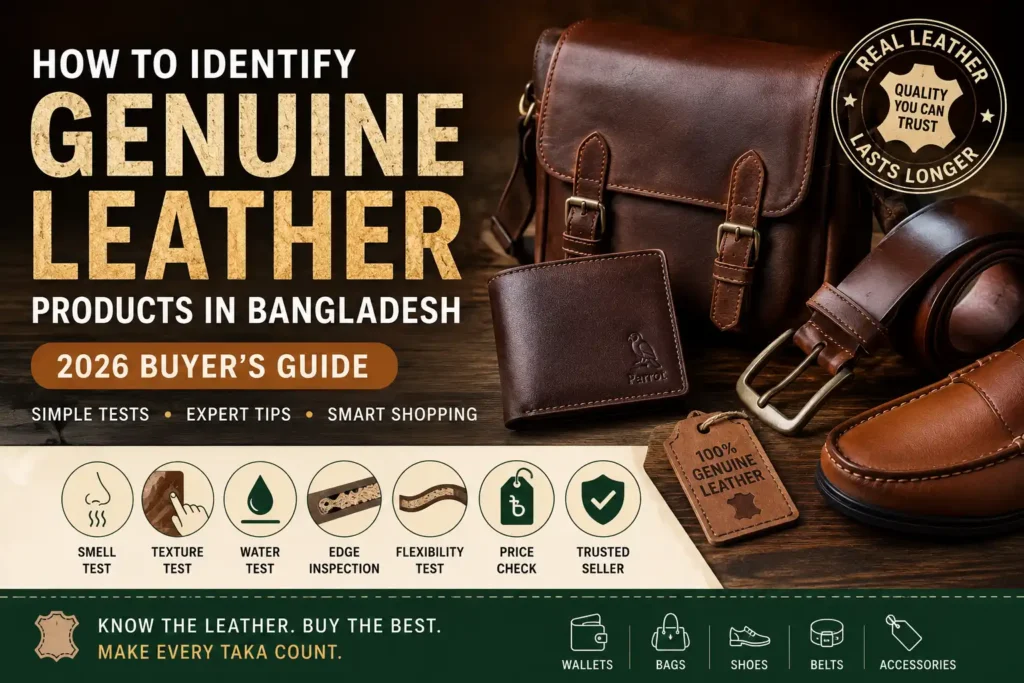
How to Identify Real Leather: 7 Practical Tests
These are the tests experienced buyers actually use — most take under a minute at the shop.
1. The Smell Test
Real leather has a distinct, earthy, slightly sweet organic smell. Fake leather smells like plastic, chemicals, or glue — or has almost no smell at all.
This is one of the most reliable quick tests. If it smells like a new shower curtain, walk away. Real leather has a natural smell that is often difficult for synthetic materials to fully replicate.
2. The Texture Test
Run your fingers across the surface, then press with your thumb.
- Real leather: Feels warm, slightly uneven, and grainy. Pressing creates natural wrinkles, like skin — because it is skin.
- Fake leather: Feels uniformly smooth, cold, and plasticky. Pressing leaves no natural wrinkling.
Also check the grain: real leather has irregular pores; synthetic has a repeating, machine-stamped pattern. If the same “pore” arrangement repeats, it’s embossed plastic.
3. The Water Absorption Test
Place a single drop of water on the surface (ask the seller first — a confident seller usually agrees).
- Real leather absorbs the drop within seconds, darkening slightly before drying back to normal.
- Fake leather typically makes the water bead up and sit on the surface, since plastic coatings absorb little to nothing.
Note: heavily coated real leather may absorb slowly, so use this test alongside the others, not alone.
4. Edge Inspection
Examine the cut edges — this is where fakes expose themselves.
- Real leather edges look slightly rough and fibrous, like suede. Even burnished or painted edges show natural fiber underneath.
- Fake leather edges look clean-cut and plasticky, often revealing a fabric or foam layer inside. A woven textile backing means PU or rexine.
On wallets, check the card slot edges; on belts, the tip and buckle end. These spots are rarely disguised well.
5. The Flexibility Test
Bend the material gently.
- Real leather bends smoothly, lightens slightly at the fold, and springs back undamaged.
- Fake leather resists stiffly or creases with sharp, unnatural lines. Cheap PU may show tiny cracks after a firm bend.
6. The Price Check
Real leather involves material, tanning, craftsmanship, and finishing costs, which usually make it more expensive than synthetic alternatives.
As a rough market guide in Bangladesh, genuine full-grain wallets are usually priced higher than synthetic alternatives, depending on craftsmanship, leather grade, and brand quality. If a “100% genuine leather” product is priced far below comparable items in the market, the price itself is telling you something the seller won’t.
That said, expensive doesn’t automatically mean genuine — some sellers price fakes high to appear legitimate. Use price as a filter, not as proof.
7. Label Verification
Check tags, stamps, and descriptions carefully:
- “Full-grain” or “top-grain” are good signs. “Leather finish,” “leatherette,” “PU leather,” or “vegan leather” all mean not real leather.
- Reputable Bangladeshi brands state the leather type openly and answer sourcing questions. Brands like Parrot Leather Crafts, for example, specify the grade on their product listings — transparency is itself a trust signal.
- Don’t rely on an embossed “Genuine Leather” stamp alone: that phrase can describe the weakest grade, and counterfeit stamps are common in local markets.
Common Fake Leather Tricks in Bangladesh
Knowing the local tricks makes you a harder target. The most common ones in Dhaka, Chattogram, and online marketplaces:
- The “export leftover” story. Claims of surplus from European export orders — sometimes true, often a cover story for PU products with foreign-looking tags.
- Mixed-material products. The front panel is real leather (so it passes your smell test), while the interior, card slots, and lining are synthetic. Test multiple parts, especially interiors.
- Heavy coating on low-grade leather. Bonded or split leather gets a thick PU coating and a stamped grain, then sells as “premium.” Edge inspection catches this.
- Fake brand stamps. “Genuine Leather” or even fake international brand logos hot-stamped onto PU. A stamp costs the seller almost nothing.
- Online photo bait. Listings show photos of real leather, then ship PU copies. Buy from pages with a physical address, consistent reviews over time, and a clear return policy.
- “Burn test” theater. Some sellers burn a separate leather scrap to “prove” authenticity, then hand you a different product. Only trust tests done on the actual item.
Genuine Leather vs PU Leather vs Synthetic Leather
A straight comparison to keep in your head while shopping:
| Feature | Genuine Leather | PU Leather | Synthetic/Rexine |
|---|---|---|---|
| Smell | Earthy, organic | Chemical/plastic | Plastic or odorless |
| Feel | Warm, grainy, softens over time | Smooth, slightly rubbery | Cold, uniform |
| Water drop | Absorbs slowly | Beads up | Beads up |
| Aging | Develops patina, improves | Peels and cracks in 1–2 years | Cracks, fades fast |
| Edges | Fibrous, suede-like | Fabric/foam layer visible | Woven backing visible |
| Lifespan | 5–15+ years | 1–3 years | Under 1 year of daily use |
| Repairability | Can be restitched, conditioned | Rarely worth repairing | Not repairable |
PU isn’t a scam by itself — it’s a legitimate budget material when sold honestly as PU. The problem in Bangladesh is PU sold at genuine leather prices under a genuine leather label.
Where to Buy Genuine Leather Products in Bangladesh
You have several reliable options in 2026:
Dedicated leather craft brands. Bangladesh has a growing scene of specialized makers who work directly with local tanneries and publish their leather grades openly. Parrot Leather Crafts is part of this movement, producing wallets, belts, shoes, bags, and accessories from properly graded hides — the kind of maker where you can ask “which grade is this?” and get a straight answer.
Established showrooms. Long-running retailers in Dhaka’s major shopping areas have reputations to protect, and physical showrooms let you run the smell, texture, and edge tests before paying.
Tannery-adjacent outlets. Shops near the Savar leather zone sell direct-from-tannery goods at fair prices, though quality varies — your testing skills matter most here.
Before committing to any purchase, compare several brands side by side: leather grades, stitching quality, warranty or exchange policies, and how transparently they answer questions. You can also explore this detailed guide on top genuine leather brands in Bangladesh to compare trusted local leather companies, products, and buying options before making a final decision.
A note on online buying: if you can’t physically test, order only from brands that state the leather grade in writing, offer returns, and have long, consistent customer feedback — not a page created last month.
Why Buying from Trusted Brands Matters
A trusted brand changes the economics of your purchase:
- Accountability. A brand with a name to protect will replace a defective product; an anonymous marketplace seller will block you.
- Consistent grading. Reputable makers use the same grade batch after batch; bazaar sellers buy whatever is cheapest that week.
- After-sales support. Good brands advise on care and offer repairs — genuine leather is repairable.
- Honest labeling. When Parrot Leather Crafts or any serious craft brand labels a wallet full-grain, that claim is checkable and their reputation depends on it.
The few hundred extra taka you pay a trusted brand is effectively insurance on the entire purchase.
Leather Care Tips After Buying
Genuine leather rewards a little maintenance with years of extra life — especially in Bangladesh’s humid climate:
- Keep it dry. If your bag or shoes get soaked in monsoon rain, blot with a soft cloth and air-dry away from direct sunlight. Never use a hairdryer.
- Condition every 2–3 months. A little leather conditioner keeps the material supple, prevents cracking, and helps resist mold in our humidity.
- Watch for fungus in monsoon season. Store leather in breathable cotton bags with silica gel packets — never sealed plastic, which traps moisture and invites mold.
- Clean gently and rotate. Wipe with a slightly damp cloth (no detergents or alcohol), and let daily-use items rest a day between uses.
Common Buyer Mistakes to Avoid
- Trusting the stamp alone. “Genuine Leather” embossed on a product proves nothing by itself.
- Testing only one spot. Fakes often mix real and synthetic panels — test the front, interior, and strap.
- Chasing the lowest price. Genuine leather has real material and labor costs — if a “full-grain” product is priced like a cheap synthetic one, it very likely is one.
- Buying online without a return policy. No returns means no recourse when the “leather” bag arrives smelling like a raincoat.
- Ignoring stitching and hardware. Genuine leather is wasted on weak thread, crooked stitching, or jamming zippers. Craftsmanship matters as much as material.
- Skipping care after purchase. Real leather neglected in a humid drawer can grow mold. Five minutes of care a month protects your investment.
Final Buying Checklist
Run through this before handing over your money:
- Smells earthy and organic, not chemical
- Surface feels warm and grainy; wrinkles naturally when pressed
- Grain pattern is irregular, not repeating
- Water drop absorbs slightly instead of beading
- Cut edges look fibrous, with no fabric/foam layer visible
- Bends smoothly and springs back without cracking
- Price is realistic for genuine leather in the local market
- Leather grade (full-grain/top-grain) is stated clearly, not just “genuine leather”
- Seller answers grade questions confidently and offers a written return policy
- Stitching is straight, tight, and even; hardware feels solid
If a product passes most of these checks, it is more likely to be genuine leather and worth considering.
Conclusion
Identifying genuine leather in Bangladesh isn’t complicated — it just requires knowing what fakes can’t imitate: the smell, the natural grain, the fibrous edges, and how real hide responds to touch and water. Combine those quick tests with a realistic sense of pricing and a preference for transparent brands, and you’ll never overpay for plastic again.
Bangladesh has a strong and growing leather industry, and buyers here deserve products made from it. Whether you’re picking up a wallet, belt, shoes, or a work bag — from a heritage showroom or a quality-focused local maker — two minutes of testing at the counter will pay you back for years to come.
Frequently Asked Questions (FAQ)
1. What is the fastest way to check if leather is real?
The smell test. Real leather has a distinct earthy, organic scent that synthetic materials rarely replicate well. Combine it with a press test — real leather wrinkles like skin under your thumb — and you can judge most products in under a minute.
2. Does “Genuine Leather” stamped on a product mean it’s high quality?
No. “Genuine leather” is actually one of the lower grades of real leather, made from the weaker under-layers of the hide — and it’s the phrase most commonly faked on PU products. Look for “full-grain” or “top-grain” instead.
3. What is a fair price for a genuine leather wallet in Bangladesh?
Prices vary with leather grade, craftsmanship, and brand, so there is no single fixed figure. As a rule, genuine full-grain or top-grain wallets cost noticeably more than synthetic ones — if a “genuine leather” wallet is priced like an obvious budget item, it is very likely PU or bonded.
4. Is PU leather bad?
Not inherently — PU is a reasonable budget material when sold honestly and priced accordingly. The problem is PU sold as genuine leather at genuine leather prices. Expect PU to last 1–3 years versus 5–15+ years for real leather.
5. Can I do the burn test to check leather?
The burn test works (real leather chars and smells like burnt hair; plastic melts), but most sellers won’t let you burn their stock — and some stage burn tests on separate scraps. The smell, texture, water, and edge tests give reliable answers without damaging anything.
6. How do I check leather products when buying online in Bangladesh?
Shift your checks to the seller: insist on listings that state the exact grade in writing, read reviews spanning months, confirm a return policy, and prefer brands with a physical address or established presence.
7. Why does my leather bag get moldy during monsoon season?
Humidity. Leather is organic, and monsoon moisture encourages fungal growth on neglected items. Store leather in breathable cotton bags with silica gel, never sealed plastic, and condition it regularly.
8. Which leather grade should I choose for daily use?
Full-grain for maximum durability and the best aging; top-grain for a slightly lower price with excellent longevity. Avoid bonded leather entirely for daily-use items like wallets and belts.
9. How long should a genuine leather product last?
With basic care, a full-grain wallet or belt should last 5–10 years or more, quality shoes 4–8 years with resoling, and bags a decade or longer. If a “leather” product peels within a year or two, it was almost certainly synthetic.